





The US Federal Reserve held its first meeting of 2026 from Tuesday (January 27) to Wednesday (January 28) amid growing tensions between Fed independence and the Trump administration.
The central bank met analysts’ expectations by maintaining the federal funds rate in the 3.5 to 3.75 percent range. After three consecutive cuts at the end of 2025, the Fed decided to hold the line on interest rates. The board welcomed some positive signs of stabilization in the US economy, but has decided to take a “wait-and-see” approach.
The Fed has a dual mandate to promote maximum employment and price stability.
For several months now, its Board of Governors has been split between those concerned with preventing a further slowdown in the US labor market and those fearing the fight against inflation is far from over.
The Fed’s preferred inflation metric, the Personal Consumption Expenditures (PCE) price index, came in above the 2 percent target, landing at 2.8 percent for November 2025. Meanwhile, Bureau of Labor Statistics data shows that the US economy added a modest 50,000 jobs in December 2025 compared to 56,000 jobs added in the previous month.
A weak labor market in the face of entrenched inflation has left the Fed in a pickle.
Lowering rates in turn lowers the cost of borrowing, which can provide businesses with more runway to grow their workforce. However, increasing available money supply by easing access to borrowing can also increase inflation.
The split between doves and hawks that began in late 2025 is still plaguing the Fed into the new year, which promises to see current Chair Jerome Powell replaced with someone more likely to be on board with the much lower rate environment desired by the Trump administration. Two Fed board members cast dissenting votes against holding rates steady, including Governor Stephen Miran and Governor Christopher Waller, who both pushed for a 0.25 percent cut.
“Economic activity has been expanding at a solid pace,” explained the Fed. “Job gains have remained low, and the unemployment rate has shown some signs of stabilization. Inflation remains somewhat elevated.”
The unemployment rate ended 2025 at 4.4 percent. While that’s historically low, data also shows limited job vacancies, and low rates of new hiring. Business Insider reporter Madison Hoff notes that economists are calling this a “low-fire, low-hire environment” due to uncertainty over where the economy is headed.
“It’s likely Fed leaders will stick to the status quo in January, in hopes that steady rates will push inflation closer to their 2% goal,” she wrote. “Affordability is a major concern for American households, as prices rise on housing, groceries, healthcare, and more. Powell has consistently prioritized price stability during his time as chair.”
During a press conference following the rate decision, Powell was careful not to commit to any future rate cut timeline. While the board still sees “some tension between employment and inflation,” that is moderating, and the Fed no longer sees any big risk either of accelerated inflation or a further significant breakdown in the labor market.
There’s also not much chance of a rate hike, either.
“We don’t take things off the table, but it isn’t anybody’s base case right now,” said Powell.
While PCE remains elevated at 2.8 percent, Powell noted that if the impact of tariffs were removed that figure would be hovering just above 2 percent. He explained that the Fed thinks this impact is largely in the rear-view mirror now.
Any day now, US President Donald Trump is expected to announce a replacement for Powell, whose term expires in May 2026. Trump has criticized the Fed and Powell in particular, saying they haven’t lowered rates quickly enough.
On October 27, US Secretary of the Treasury Scott Bessent announced a shortlist of candidates to replace Powell, including Fed governors Christopher Waller and Michelle Bowman, National Economic Council Director Kevin Hassett, former Fed Governor Kevin Warsh and BlackRock (NYSE:BLK) executive Rick Rieder.
The Wall Street heavyweight is reportedly the favored candidate at the moment.
“Under Warsh, the Fed would likely signal a preference for a smaller footprint. Despite recent support for near-term rate cuts, his longer-standing views favor a scarce-reserves framework and balance-sheet reduction, which markets would associate with higher term premium and greater yield-curve volatility,” he added.
Trump’s feud with the Fed escalated earlier this month, when the US Department of Justice served the agency with grand jury subpoenas, threatening a criminal indictment over Powell’s testimony to the Senate Banking Committee this past June. In addition to that, last week, the Supreme Court sat for oral arguments over whether Trump can legally remove Fed Governor Lisa Cook from her position over allegations of mortgage fraud.
Although Powell batted away any political questions from reporters during the press conference, he did acknowledge that the Supreme Court case between Trump and Cook is the most “important legal case in the Fed’s 113-year history.’
The gold price spiked to a new high of US$5,361.31 per ounce after the Fed’s decision, although much of that boost likely came from a much weaker US dollar, which is trading at four year lows. Silver traded in a range of US$110 to US$116 per ounce, just below the all-time high of US$117.72 per ounce set on Monday (January 26).
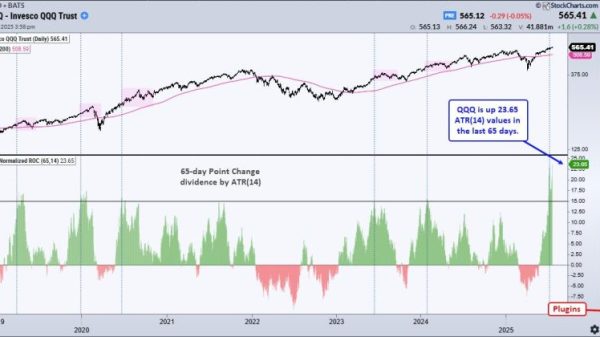
Equities reactions were fairly muted following the rate announcement on Wednesday, with the S&P 500 (INDEXSP:INX) up 0.083 percent to reach 6,972.78. Meanwhile, the Nasdaq-100 (INDEXNASDAQ:NDX) gained 0.31 percent to come in at 26,020.9, and the Dow Jones Industrial Average (INDEXDJX:DJI) was down 0.0064 percent, coming to 49,000.29. It seems Wall Street had already factored in the Fed’s decision to hold.
The next Fed interest rate decision will come on March 18, the second to last Fed meeting before Powell’s term as chair comes to an end. Most analysts expect interest rates to remain in a holding pattern until the second half of 2026.
Securities Disclosure: I, Melissa Pistilli, hold no direct investment interest in any company mentioned in this article.